


Act I: Strange encounters
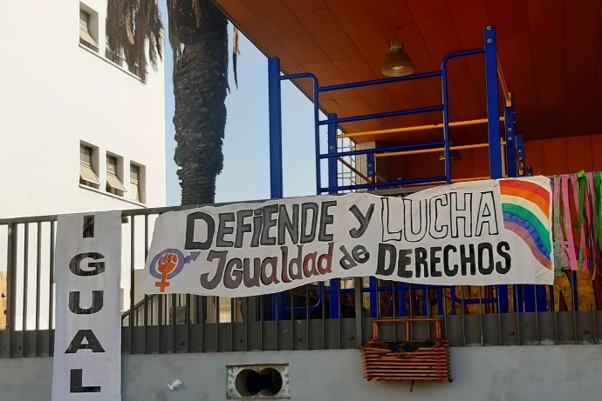
As a Southeast European anthropologist from Bosnia and Herzegovina, arriving at an LGBTQI+-friendly high school in Santiago de Chile was a profound cultural shock. As was the case with many other high schools, universities, and public spaces in general in Chile, Liceo de Aplicación—the school in which I conducted ethnographic research for my doctoral dissertation in social anthropology—was likewise affected to a great degree by the feminist movement that shook Chilean society in 2018 and reshaped the norms of public conduct and opinion regarding questions of sexuality and sexual identity..
During my stay, the situation at the school was such that the famous feminist green scarf was placed over the statue of the founder of the school and there were no open macho commentaries allowed in the public. At the same time, queer students not only organized under the umbrella of Cogesex (the Committee on Sexuality and Gender), but also became fully integrated into the social life of the school, forming an important part of the dominant current in student politics, in which ending the patriarchal education system emerged as one of the movement’s central demands. As a result, during my stay it became quite normalized that many students paint their nails and eyebrows, teachers and student organizations used inclusive non-binary language in their teaching and statements, gender and sexuality was included as a special section in class on civic education, and queer students got elected to several positions within student government.
One day, the teacher I was working with and I observed from the balcony a new mural being painted by Cogesex on the school’s steps. As we watched the boys writing that “the future is non-binary,” that “love is love and not a condition,” and that “only without fear can we be free” within a world where “girls could wear pants and have a penis, and boys could wear skirts and have a vulva,” the teacher I was working with—who himself felt that all of this had gone a bit too far—turned to me and asked: “Igor, could you imagine this happening in Bosnia?”
Remembering my response—that I “could not imagine this even in my wildest dreams” because “Chile and Bosnia belong to different worlds”—I turn in the following section to the story of Damir, a young queer student whom I befriended during school ethnography I conducted in a small town in central Bosnia several months after returning home from Chile.
Act II: Queer youth in Central Bosnia
Unlike the queer youth I met in Santiago, who were very open and outspoken about their sexual identities, Damir—the only queer person I befriended during my stay at a high school in central Bosnia in 2023—invested a great deal of effort and life energy into concealing his identity from the society in which he lived. Nevertheless, while very secretive about his identity, Damir was very open in his criticism of school culture during interviews and coffees that we had together. This culture, which he viewed as steeped in a toxic masculinity that was misogynistic, homophobic, and sexist, and embodied above all by the figure of Andrew Tate, was very popular among the boys at the school during my stay. It forms the very basis of the queer story I present in this section.
According to his interpretation, Damir lived inside a conservative culture of “balkonaši” (people who are limited and closed off in their thinking like a balcony) which was brought to the spaces of the school by the boys arriving from both the surrounding villages and the town itself. The constant navigation of this “unfriendly space” that “did not allow for diversity” made Damir very anxious—so anxious that, on many days, he dreaded the prospect of spending another day at the institution. As he told me, Damir neither felt free to dress in the way that he wanted nor to express what he really wanted to express. In his strive to not be noticed, called out, or criticized, on many days Damir would just decide to put on sweatpants for confronting another day at school, in order to camouflage and fit in within a space in which the majority of boys wore either black or grey colors. Damir told me that he learned about his unacceptable preferences already in his childhood when, as a kid, he could not fit into the company of boys who only knew how to talk about war-related topics that did not interest him. During many of these instances, he was pushed away and told to “go and play with the dolls.”
Damir's two favorite teachers at school were Nejra and Ivana, two feminists in their thirties who dyed their hair green, led unconventional student workshops, and were considered hippy weirdoes by other teachers and the wider society of the town. Besides these two teachers, Damir also found support within the school in two female friends, one of whom he described as a “tomboy.” As a “woke kid” at school, Damir found acceptance and a sense of safety in their company. While he also had one close male friend at the school, Damir was disappointed that the two of them only hung out outside of the school premises. Damir told me that the other boy was afraid of what people might think if they saw him in Damir’s company. He recalled that the boy once even threatened to stop greeting him if he decided to get a dragonfly tattoo on his shoulder—which he ultimately chose not to do.
On several occasions during our conversations, Damir referred to “The Fortress”, the novel written by Meša Selimović, as the work that best illuminated the situation he was living in within his town. As he was describing this ambiance that is “filled with muškarčine (bos. tough guys)”, Damir said that “this is like when someone is a lesbian and the whole society condemns them immediately.” Saying how “this is not normal for us” since “we are a place in which society immediately condemns all those who are different”, Damir came to describe his town as a prison that suffocated him and which he wanted to leave for a place that is not so conservative. Damir told me that the same thing had happened to his two favorite teachers, whom he described as “the sun that illuminated the school,” but who ultimately had to leave because “they were just too different,” “could not fit into the environment of this small and conservative town,” and were, in his view, essentially “expelled by society.”
On several occasions during our conversations, Damir emphasized how eager he was to finish school and leave the town behind. As he remarked: “The town is beautiful, but only for a visit. It is not a place to live. Run away from here—that is what I tell everyone.” In the end, Damir left to study in Germany. As he was leaving he told me how he “was happy that he will not have to stand these people anymore” and how he was “happy to go to a place where no one really cares how you dress or what you do.” Speaking about his friend of Croat ethnicity, whom I did not befriend myself but whom I also suspected might be queer, Damir said: “People like Luka—the people who could really change something—are the ones whom society in towns like these prefers to push away because they are too different.”
Act III: Masculinities against homophobia
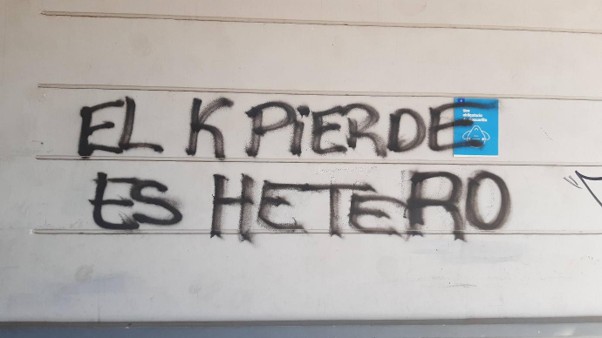
On May 17, 2022, the International Day Against Homophobia, a politicized group of both heterosexual and queer students at Liceo de Aplicación, the high school where I conducted ethnographic research in Santiago de Chile, decided to mark the occasion by breaking into the office of the school’s head inspector and attempting to set it on fire. The official reason behind it was an accusation of homophobia against the inspector, who was said to have used homophobic insults against non-heterosexual students participating in the mobilization at the school.
Regardless of whether I could support this type of action, which itself was far from being devoid of hegemonic masculinity, I could not help but ask myself: “Could this happen in Bosnia?”
The real answer to this question lies in another question: Why not? Why are we so different? Why do we seem to stand worlds apart? What kind of experience would Damir have had if he had been born in Chile and attended Liceo de Aplicación? The answer to this question is far from unidirectional and does not seek to reveal any kind of straightforward or non-binary logic.
_______________________________________________________________
About author:
IGOR STIPIĆ is a social anthropologist and educator whose work sits at the intersection of political anthropology, education, and youth studies. He holds a BA in Economics from Lake Forest College in Illinois, an MA in Political Science from the University of Economics in Prague, and an MA in Sociology from Universidad Alberto Hurtado in Santiago de Chile.
After working for seven years as a researcher and lecturer at the Institute of Advanced Studies in Kőszeg and the University of Sopron, Igor was awarded a Leibniz Science Campus scholarship to pursue a PhD in Social Anthropology at the University of Regensburg.
His dissertation, titled Abandoning States: Class, Violence, and Emotions at a Public High School in Santiago de Chile, examines how working-class youth from the Chilean capital come to theorize the state through political engagement that results in situated and embodied understandings of classed violence that they and their families experience within the social world they inhabit. Over the past decade, Stipić has conducted fieldwork in Southeast Europe and Latin America, and has published in both international academic journals and popular magazines on topics covering youth politics, collective memory, education, and social movements.