Written by: Vuk Gorki
The article examines the formation of the anti-abortion movement in Croatia and its expansion into Bosnia and Herzegovina. The author maps the individuals and civil society organizations of a Catholic worldview that have been actively campaigning against abortion in Croatia from the 1980s to 2026. At the same time, the author introduces and traces the feminist struggle against these actors.
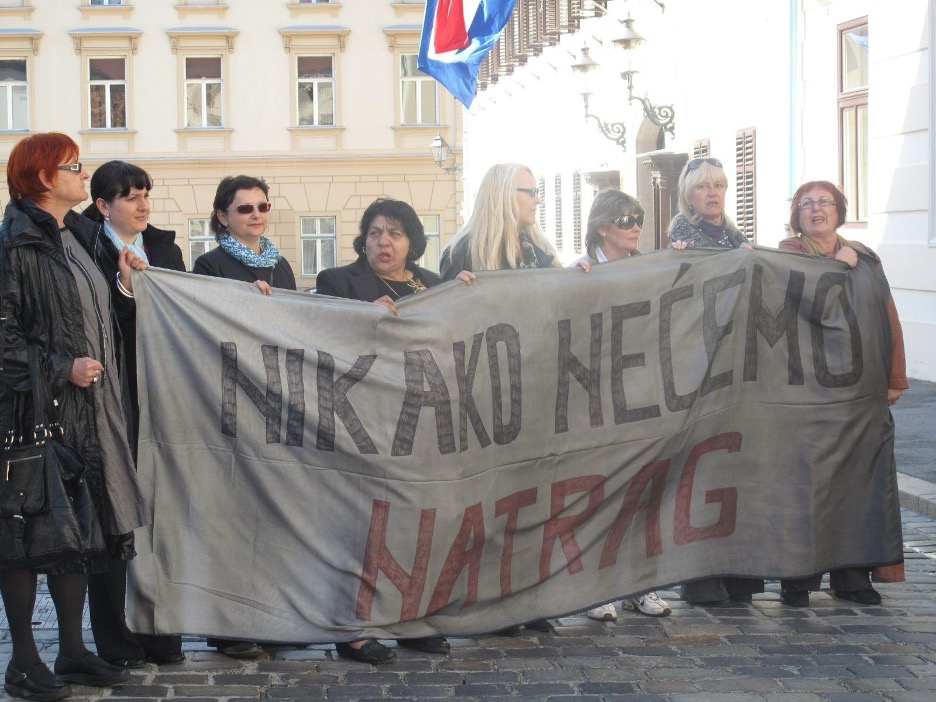
Protest in front of the Croatian Government, 13 April 2011. (Photo: Archive of the Center for Women War Victims – ROSA, Zagreb)
One cannot walk down Vlaška Street without encountering Nela Pamuković. It is a part of Zagreb she passes through every day. In the late 1980s, as a member of the Women's Group Trešnjevka, she and other feminists set up an information stand in Flower Square (Cvjetni trg). Their focus was on criticizing gynecological practices. Many women had negative experiences during gynecological examinations and childbirth. For this reason, she distributed leaflets on women's health and reproductive rights together with other activists.
“Gynecology appropriated women’s knowledge from midwives, and gynecologists were mostly men,” she says. Still active in advocating for women’s rights, she points out that during that period “childbirth was often quite cruel.”
A good example is the story Diary of a Woman Giving Birth by Jasenka Kodrnja, who was also a member of the aforementioned feminist group. It was published in 1981 in Start, one of the most widely read Yugoslav magazines.
The Women's Group Trešnjevka in Zagreb focused on women's rights. It chose violence against women as its main priority. In 1988, it established the first SOS hotline for women victims of violence. Two years later, it opened the first women's shelter in Eastern Europe.
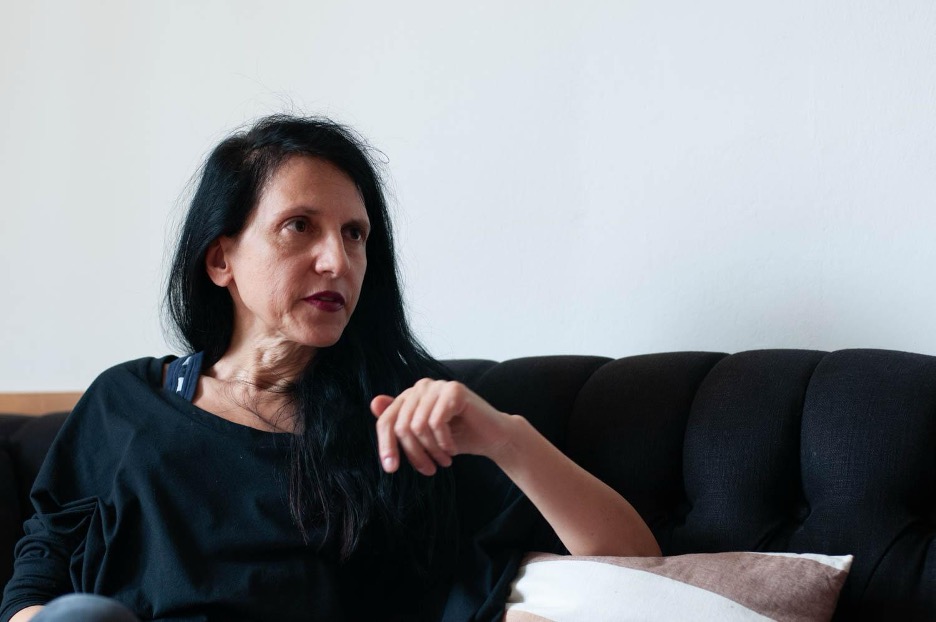
Nela Pamuković is a pioneer of second-wave feminism in Yugoslavia. (Photo: Jusuf Hafizović).
Although information was scarce at the time, Nela Pamuković was aware that there were individuals active in opposing abortion. Among them were Father Anto Baković, Marijo Živković, physician Antun Lisec, and university professor Ante Vukasović. It was a period when many different issues were being questioned and debated. Institutions of the Catholic Church were among the places where such ideas and materials were disseminated.
With the breakup of Yugoslavia and Croatia’s independence, Father Anto Baković became Assistant Minister for Reconstruction in 1992. A proposal for the spiritual and demographic renewal of Croatia was subsequently drafted. The Autonomous Women's House Zagreb informed the international public about it.
“Because of that, the proposal as a comprehensive concept of so-called demographic and spiritual renewal was halted for a time,” says Nela. “However, efforts by the clerical right to ban abortion and restrict women’s reproductive rights inherited from the socialist period continued uninterrupted.”
From Marx to Conscientious Objection
A heated debate took place in Croatia in 1998 over the Family Law. Before the new law was adopted, a press conference was held in Parliament in November. It was organized by the Committee for the Coordination of Family Pastoral Care, an association of organizations with a Catholic worldview. They justified their response as an effort to protect marriage and the family.
At the event, Ante Vukasović insisted that the law should incorporate “the constitutional principle according to which every human being has the right to life,” overlooking the fact that legal personhood begins at birth. Baković also spoke, saying that the reaction had come too late, while Marijo Živković opposed measures aimed at simplifying the divorce process.
Even then, it became clear that support for such activities was coming from the affluent West. Paul Marx, a Benedictine monk, founded Human Life International, one of the first ultraconservative organizations in the United States focused on promoting abortion bans internationally. He delivered lectures in Split in 1988. Živković served as the organization's coordinator for Eastern Europe.
One of the attendees at the lectures given by the aforementioned American was physician Ružica Ćavar. Following the model of that organization, she founded the right-wing Croatian Movement for Life and the Family in 1990. A year later, the organization submitted a request challenging the constitutionality of the existing abortion law.
Abortion has been legal in Croatia since 1952. The current law dates from 1978, while the constitutional provision guaranteeing the right was adopted in 1974. However, in 2003, conscientious objection was introduced. As a result, a significant number of gynecologists refuse to perform abortions. At the same time, there have been cases of pharmacists refusing to sell contraceptives, citing their conscience as the reason.
The Invisible Network: The Influence of Opus Dei
Although anti-abortion groups, ultraconservatives, and the Catholic Church have been active since the 1980s, their activities in Croatia have intensified over the past two decades.
In October 1928, the Spanish priest Josemaría Escrivá de Balaguer founded Opus Dei. Seventy-five years later, Father Jorge Ramos and Father Julio Guijarro-Garcia arrived in Croatia. Their purpose was to expand the social influence of some of the most conservative ideas within the Catholic Church.
In every country where they operate, they do so in coordination and agreement with local Catholic Church authorities. They began their work in Zagreb from a rented apartment on Vlaška Street. The space served both as their residence and as a venue for educational and spiritual activities. Today, they have their own center in the Croatian capital, which also includes a student residence.
By searching the organization’s website, one can learn that it offers young people “activities aimed at the formation of students and working youth, such as lectures on Christian doctrine, spiritual guidance, cultural events, and socially engaged projects.”
In 2004, the weekly magazine Nacional described the Catholic organization as “a threat to national security.” According to the same publication’s investigation, agents of the Croatian Counterintelligence Agency identified the most important associates of the organization’s Croatian branch.
Among them were members of the Croatian Catholic Association “Mi” (“We”). Nacional also identified several other prominent individuals, including Tomislav Karamarko, then a close associate of Croatian President Stjepan Mesić.
Also mentioned were Vladimir Lončarević, assistant to the Presidential Office’s adviser on domestic policy, and Neven Jurica, Croatia’s former permanent representative to the United Nations. The list further included senior church prelates Juraj Jezerinac and Želimir Puljić. Retired General Ivan Tolj and his brother Mario Tolj, a parish priest in Zagreb, were identified as important links in the network.
“Members of this Catholic organization have penetrated the highest business and political circles and wield significant influence over the state of affairs in the country,” university professor Jadranka Brnčić told Novosti journalist Dragan Grozdanić in 2019.
Democracy, she argued, is not something in which they place much faith. “According to their elitist understanding of society, authoritarian regimes suit them better,” said the Zagreb-based professor. She explained that the main goal of Opus Dei is “to steer society in a particular direction, toward an increasingly prominent role for the Catholic Church—one in which the Church determines society’s moral values and a society that is otherwise multiconfessional and pluralistic is guided by a narrowly defined Catholic worldview.”
Around seventy percent of Opus Dei members are married men or women. Most are lay Catholics, while a smaller proportion are priests. However, according to journalist Gareth Gore, the organization is misogynistic.
“Women vote, but whatever they vote for must later be approved by men,” he observed. Gore is the author of Opus, a book in which he describes the organization as “dangerous to itself, to its members, to the Church, and to the world.”
Opus Dei firmly upholds the Catholic Church’s opposition to abortion. On its official website, the organization emphasizes that “all initiatives that help mothers continue their pregnancies, especially when they face particular difficulties, are worthy of praise.”
Several organizations have been particularly prominent in this regard.
From Banning Sex Education to a Monument for Unborn Children
The association GROZD (Parents’ Voice for Children) was founded in 2006. It succeeded in halting the introduction of sex education in schools. Feminists had long advocated for comprehensive sex education, while the Catholic Church and organizations sharing its worldview consistently opposed such efforts.
In 2009, the Association for the Protection of Human Life from Conception to Natural Death – Bethlehem was established in Karlovac. It provides counseling to pregnant women considering abortion, as well as humanitarian assistance in the form of food and clothing for families. However, the organization traces its history much further back.
Friar Marko Kornelije Glogović first presented his vision for saving unborn children from abortion on Radio Maria in Zagreb in 1999. In 2003, in the village of Sveti Petar u Šumi, and in cooperation with the Diocese of Poreč and Pula, he founded the Center for Unborn Life.
In 2008, a monument to unborn children was erected at the municipal cemetery in Karlovac. This initiative eventually led to the creation of the Bethlehem association. The organization now has branches in several Croatian cities.
In the years that followed, a number of organizations emerged that became increasingly vocal in the public sphere. They began organizing conferences and petitions, as well as holding prayer vigils outside hospitals.
The association Vigilare was founded in 2011. It organizes anti-abortion campaigns, including petitions calling for a complete ban on abortion. Its initiative “I Was Once an Embryo Too” was most active in 2012. The campaign collected 133,000 signatures across 500 of Croatia’s approximately 1,500 Catholic parishes.
Members of the organization believe that human life begins at conception and that embryos should be granted legal protection. They also opposed the adoption of the Law on Medically Assisted Reproduction and threatened to initiate a referendum that would invalidate the legislation.
The leadership of the Catholic Church in Croatia does not publicly comment on the activities of such organizations. They neither openly support them nor distance themselves from them. Financial support for these associations likewise does not come directly from the Church hierarchy, but rather from private sources.
A similar role is played by the association Croatia for Life (Hrvatska za Život). In its name, the organization insists that the word Život (“Life”) be capitalized, contrary to Croatian capitalization conventions. The organization explains that writing Life with a capital “L” signifies “Croatia for Christ, because only Christ is the Way, the Truth, and the Life.”
Founded in 2014, the association organizes annual international conferences. In April 2026, it held its 8th conference, “Now Choose Life”, and its 7th annual Catholic men’s conference, Be a Man.
One of the organization’s programs is the 40 Days for Life initiative. The campaign originated in the United States in the early 2000s and has involved more than one million participants. Its organizers frequently highlight what they describe as the closure of dozens of abortion clinics as a result of their activism.
The initiative has been active in Croatia since 2014. It organizes prayer vigils outside public hospitals. More than 11,000 people have participated in these events across over thirty cities throughout the country.
According to its website, the initiative brings together Christians of all denominations “in a common commitment to protecting the lives of unborn children; healing women who have had abortions; the conversion of medical personnel who perform abortions, as well as politicians and activists who advocate and promote them; and providing spiritual, moral, and material support to every mother and father who are considering or have decided to abort their child.”
Croatia for Life is funded by the Christian Rhema Foundation. The foundation has also supported the associations GROZD and Vigilare. Behind it stand Ivić Pašalić, a former adviser to Croatia’s first president, Franjo Tuđman, and his wife Ksenija, as well as the business couple Ivan and Mirjana Topčić.
A New Offensive Against Reproductive Rights
In October 2014, the Women's Network of Croatia submitted complaints regarding the legality of hospital practices and demanded the enforcement of laws governing the termination of pregnancy.
Six of the nine institutions contacted responded. Four denied media reports claiming that they did not provide abortion services: Požega General County Hospital, Zagreb Clinical Hospital Centre, Zabok General Hospital, and “Dr. Josip Benčević” General Hospital in Slavonski Brod, which responded on behalf of the affiliated Nova Gradiška General Hospital.
“One hospital confirmed that it does not perform abortions—Hrvatski Ponos Knin General Hospital—which stated that all of its gynecologists had invoked conscientious objection and that, in such cases, patients were referred to other healthcare institutions according to the pregnant woman's preference,” noted Nela Pamuković.
She further pointed out that “the Ministry of Health was aware of this situation, and that if the Ministry were to issue different instructions to the hospital, the hospital would promptly act in accordance with them.”
One hospital—Našice General Hospital—reported that it had “found a physician who will perform abortions on request at Našice General Hospital, and this service will therefore be available at the institution in the future.”
Nevertheless, anti-abortion initiatives in Croatia have continued unabated. Critics argue that their aim is to place women in a subordinate position and to transform a society built on democratic values into a conservative one shaped by a Catholic worldview.
The Rise of the Clerical Right: From the Margins to Centers of Power
“Their strategy is to use positive-sounding concepts—life, family, children,” Pamuković emphasizes. “At the so-called March for Life, they carry pink and blue balloons. They used to show grim films featuring bloody fetuses and similar imagery, but then they realized how to rebrand themselves in a more positive way.”
According to Pamuković, they appropriate the language of human rights in order to pursue policies that would restrict women's rights.
The aforementioned March for Life has, since 2015, brought together and expanded virtually all existing anti-abortion initiatives. Estimates suggest that attendance at the Zagreb march ranges from 5,000 to 20,000 participants. The event is now organized in numerous cities across Croatia.
In 2026, marches were held in twenty Croatian cities under the main slogan: “The First Step Is the Law! Life Is a Gift—Let Us Protect It with a Just Law!”.
According to media reports, several Croatian politicians have participated in the event in previous years. Among them were former Minister of Culture Zlatko Hasanbegović, as well as Zagreb mayoral candidates Mislav Herman and Tomislav Jonjić. This year, the march was also joined by nationalist singer Marko Perković Thompson.
“This shows how the clerical right is becoming even more visible and assertive,” says Nela. “This year they are very explicitly calling for the abolition of abortion rights, whereas in the past they tended to foreground images of the idealized family.”
The event is also known for being attended by Dario Kordić, who was convicted by the International Criminal Tribunal for the former Yugoslavia (ICTY) for war crimes committed in Bosnia and Herzegovina.
At the same time, it should not be overlooked that, throughout the years of activity by these organizations, women’s rights activists have continued to resist and organize campaigns in opposition to their initiatives.
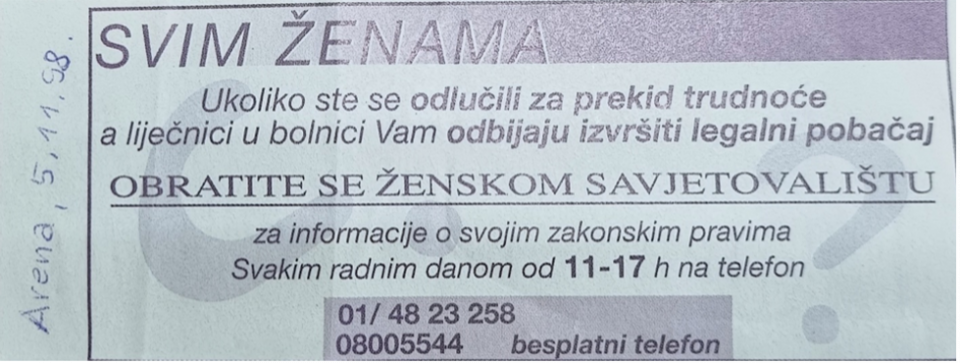
Advertisement Addressed to Women Seeking to Terminate a Pregnancy Whose Hospital Doctors Refuse to Perform a Legal Abortion, Arena, 5 November 1998. (Photo: Autonomous Women's House Zagreb)
“As early as the 1990s, we published newspaper advertisements inviting women to contact us if they needed help or if they had been denied an abortion,” Nela recalls.
Today, Croatia has a feminist support network called Brave Sisters (Hrabre sestre), which specializes in assisting women who encounter obstacles in exercising their right to access abortion services.
“We organized a large petition, protests, and public actions, and we also drafted our own proposal for an abortion law,” the activist recalls.
These activities were carried out through various organizational frameworks. In some campaigns, activists worked as part of an ad hoc coalition for abortion rights that brought together the Lesbian Group Kontra and the association B.a.B.e. (Be Active, Be Emancipated), led by Vesna Kesić.
Some of these activities were organized through the Women's Network of Croatia, while work on the legislative proposal and certain campaigns was also carried out through the Autonomous Women's House Zagreb.
The most recent public forum was held in 2023. It was broadcast from Zagreb's Bogdan Ogrizović Library on the Third Program of Croatian Radio. In addition to feminist activists, the event featured Željka Markić, daughter of Marijo Živković—the same man who campaigned for an abortion ban during the socialist period.
“Two of our women from the Women's Network completely dismantled her arguments,” says Nela.
Željka Markić is the leader of the right-wing, anti-rights organization In the Name of the Family (U ime obitelji), one of the organizers of the March for Life. She previously served as vice president of the association GROZD and was also the first president of the political party HRAST (Croatian Growth), formally known as the Movement for a Successful Croatia.
In 2016, the association In the Name of the Family (U ime obitelji) submitted a petition to the Constitutional Court seeking a review of the constitutionality of the Act on Health Measures for the Exercise of the Right to Freely Decide on Childbirth. The organization called for an almost complete ban on abortion, with the sole exception being cases in which the mother's life was at risk.
The petition was filed as a counterproposal in the constitutional review proceedings concerning Croatia's abortion law. It is worth recalling that Ružica Ćavar had already submitted her own proposal challenging the law in 1991.
The Constitutional Court of Croatia issued its ruling in 2017, taking the position that abortion could not be prohibited by law.
However, what made Željka Markić widely known to the Croatian public was her launch of the In the Name of the Family initiative. On the basis of that campaign, the association of the same name was established in 2013. It organized a signature drive to trigger a referendum aimed at defining marriage in the Constitution as a union between a man and a woman.
In December 2013, 66 percent of Croatian voters supported the inclusion of such a provision in the Constitution.
“In this way, marriage equality for all citizens was prevented,” says Nela Pamuković.
Croatia is a member of the European Union, which facilitates connections among like-minded actors across national borders. When the state does not formally support the ideas promoted by these organizations, support is often sought from abroad.
In 2019, the Croatian branch of the Ordo Iuris Foundation for Legal Culture was established. Founded in Poland, Ordo Iuris played a key role in campaigns that led to a near-total abortion ban in this country.
It is a group of Polish ultraconservatives. They offer legal, advisory, and financial assistance to individuals whom they perceive as being targeted because of views they consider Christian. They promote a heterosexual, traditional, and patriarchal understanding of the family and seek to influence legislative frameworks across Europe.
The organization also has representatives within European Union institutions. One of its leaders in Croatia, Ivan Prskalo, was third on the candidate list of the political party MOST in the elections for the European Parliament.
Yet none of this is without consequence, and the legal system has, at times, recognized the threats posed by the foundation's activities. For example, in May 2026, the Zagreb County Court ruled in favor of the association Dugine boje (Rainbow Colors) in a case brought against Ordo Iuris.
The court found that the campaign “Christ and Homeland” (Krist i domovina) amounted to the harassment and discrimination of LGBT people. It ordered the removal of the campaign's content, including the website kristidomovina.hr.
Although lawyers, state institutions, and civil society organizations continue to do what is within their power, ultraconservative groups are making significant efforts to impose their ideology on society.
If you happen to find yourself in Zagreb on the first Saturday of the month, you may encounter the Knights of the Immaculate Heart of Mary (Vitezovi Bezgrešnog Srca Marijina) in Ban Jelačić Square. These are organized groups of Catholic men who gather to kneel and pray in public spaces. In addition to the capital, similar gatherings can be seen in the central squares of other Croatian cities.
They first appeared in Poland and Australia, while in Croatia they have been gathering since October 2022 at the invitation of the Be Masculine (Muževni budite) project, an initiative of Croatia for Life.
Among the group's most prominent figures is Vice Batarelo, the leader of the previously mentioned association Vigilare. He is also connected to the Ordo Iuris Foundation. A returnee from Australia, Batarelo once headed the Office for Family Pastoral Care of the Archdiocese of Zagreb, though he was later removed from that position. He has been a vocal public opponent of women's rights and LGBT rights.
Exporting Ideology: The Ultraconservative Wave in Bosnia and Herzegovina
Bosnia and Herzegovina and Croatia share a border stretching more than one thousand kilometers. In addition, according to the 2013 census, Croats, who are mostly Catholic, make up 15.4 percent of Bosnia and Herzegovina’s population. The influence of ultraconservative groups from Croatia has also spilled over into Bosnia and Herzegovina.
In 2016, lawmakers Deni Ćosić of the right-wing Croatian Alliance HKDU–HRAST and Marija Češkić of the Croatian Party of Rights Dr. Ante Starčević (HSP Dr. Ante Starčević) in the West Herzegovina Canton drafted a bill intended to protect life “from conception to natural death.” The proposed legislation sought to prohibit the trade in fetuses, the “creation of hybrid beings,” euthanasia, and abortion. However, the bill never reached the parliamentary agenda.
From the same canton, the association Mlado Sunce (Young Sun), founded in Široki Brijeg in 2017, erected billboards across Herzegovina in 2019. The imagery depicted a womb in which a baby was connected to its mother's heart by an umbilical cord, with a pair of scissors positioned beneath it and the slogan: “Don't Give Me Up, Mother!” (Ne daj me, majko!)
Additionally, the country's capital Sarajevo is home to three counseling centers for unwanted pregnancies that promote similar views. The oldest among them is Svjetionik – Center for Life (Svjetionik – Centar za život), founded in 2001 by Bob and Eileen Pressler. The couple arrived in Bosnia and Herzegovina in 1998 as Catholic missionaries from the United States.
Another is Voice for Life (Glas za život), an initiative launched as a project in 2016 and formally registered as an association in 2020. The association also operates the online counseling service Sara – A Place for You (Sara – Mjesto za tebe).
Journalist Azra Husarić Omerović found that these organizations are not transparent with the public regarding their finances and frequently withhold information about their staff. Nevertheless, the fact-checking platform Raskrinkavanje.ba established that two of them—Voice for Life (Glas za život) and Svjetionik – Center for Life (Svjetionik – Centar za život)—are affiliated members of Heartbeat International.
Heartbeat International is a Christian anti-abortion network founded in the United States in 1971. It brings together organizations from various Christian denominations and operates on six continents, in more than 100 countries, through a network of over 4,000 affiliated centers.
In Mostar, a city widely regarded as the center of Croatian politics in the multi-confessional state of Bosnia and Herzegovina, Catholic men have been gathering in the main square since 2023 to kneel in prayer.
Since 2015, periodic forty-day public anti-abortion prayer vigils have also been held outside the University Clinical Hospital in Mostar.
The interconnected nature of these organizations on both sides of the border is perhaps best illustrated by the fact that, in 2017, one of the leaders of the association Mlado Sunce (Young Sun) was Marko Topić, who also served as the coordinator of the 40 Days for Life initiative in Croatia.
In Bosnia and Herzegovina, a deeply divided society, there is no single law governing sexual and reproductive health. Nor is there a national program or state-level strategy in this area. Instead, these issues are regulated by the country's constituent administrative units—the two entities, the Federation of Bosnia and Herzegovina and Republika Srpska, as well as the self-governing Brčko District.
The relevant laws permit abortion up to the tenth week of pregnancy.
In Republika Srpska, conscientious objection has been introduced into the healthcare system. This right is limited in cases where there is an obligation to provide emergency medical care in situations involving an immediate threat to life or a risk of severe harm to a person's health.
In the rest of the country, no such legal provision exists. Nevertheless, abortions are not performed in one canton of the Federation of Bosnia and Herzegovina and in part of the city of Mostar.
“In Canton 10 (Livno Canton), this issue is not regulated by legislation, and we believe that abortion should be addressed by introducing a complete ban on abortion in Bosnia and Herzegovina,” the cantonal Ministry of Labour, Health, Social Welfare and Displaced Persons told the Sarajevski otvoreni centar (Sarajevo Open Centre) in 2024.
According to the 2013 census, 41,784 women lived in the canton. More than half of them were adults.
The Mostar hospital outside which the 40 Days for Life initiative holds its prayer vigils is also among the institutions that do not perform abortions, except in cases where the woman's life is at risk or the fetus has severe abnormalities.
According to reporting by Detektor.ba, a specialized online outlet that monitors the judiciary and reports on war crimes, corruption, terrorism, and organized crime, the hospital's director, Ante Kvesić, stated in February 2026 that he saw no issue with prayers being organized on hospital grounds. At the time, the Ministry of Health of the Herzegovina-Neretva Canton declared itself not competent to address the matter, while the Federal Ministry of Health did not respond to journalists’ inquiries.
Meanwhile, billboards bearing the slogan “Choose Life” appeared across Herzegovina, signed by the 40 Days for Life initiative.
Journalist Matea Jerković of Oslobođenje also found that the initiative's social media posts include quotations from the Croatian nationalist singer Marko Perković Thompson about Europe's Christian roots. The posts likewise feature excerpts from sermons on abortion by the Zagreb archbishop and cardinal Alojzije Stepinac, who was convicted after the Second World War for collaboration with the Ustaša regime in the persecution and extermination of Serbs and Jews.
The 40 Days for Life initiative has received support from the Catholic Church and from media outlets close to it in Bosnia and Herzegovina. It has also been covered favorably by the entity-level news agency FENA, as well as by the state broadcaster BHRT.
A Civilizational Step Backward: Challenges of a New Era
Nela Pamuković closely follows developments related to women's rights. She attends conferences, gives lectures, and speaks with journalists. At times, her protests against organizations seeking to curtail women's reproductive autonomy have even resulted in her being detained.
Nevertheless, she continues to use her voice and influence to engage with and respond to developments across the region once known as Yugoslavia.

Nela Pamuković Continues Her Fight for Women's Right to Make Their Own Life Choices. (Photo: Jusuf Hafizović).
At times, she feels the struggle is futile. Yet she refuses to give up. During the breakup of Yugoslavia, she protested against the war and helped care for refugees from Bosnia and Herzegovina. Later, she became a prominent advocate for LGBT equality.
As she sits in a café in the city where she grew up, dressed in black—the color of a goth—the image seems fitting. It is also a reminder of the somber tone that patriarchy has long imposed on women in this region. Nela is one of the pioneers of second-wave feminism in Yugoslavia.
“Back in the 1980s, many of us in Zagreb wore black—punk, gothic,” she says, sipping hot chocolate on Preradovićeva Street. “It was a form of resistance to the mainstream.”
She goes on to list some of the bands that defined the era: Bauhaus, Laibach, and The Damned. The West was something to aspire to. It was not unusual for her to take a train to Ljubljana for the day. Slovenia was the most open republic of the federation in which the activist was born.
Women in Yugoslavia gained full voting rights and formal legal equality in 1945, at a time when many women elsewhere in Europe were still fighting for the same rights. Socialism brought significant progress in many areas. Yet problems persisted, particularly with regard to violence against women.
There were also challenges stemming from the double burden placed on women—at work and at home—as well as concerns about the promotion of pornographic representations of women. These were among the issues on which feminists campaigned for change.
At the same time, reproductive rights were considered one of the era's major achievements, including access to abortion and rights related to maternity leave.
The socialism that was often regarded as flawed was, in some respects, more progressive than what followed. At the same time, the anti-rights efforts directed against women that this article examines are unfolding at a moment often seen as the height of modern civilization—a period in which the scope and limits of human freedoms are perhaps being debated more intensely than ever before.
VUK GORKI is a journalist and political scientist from Bosnia and Herzegovina whose work focuses on issues of social justice and human rights.
The article is part of publication “FORWARD WITH HOPE Creative Responses to Anti-Gender Movements”, developed within the Global Campus Alumni Cross-Regional Projects 2025-2026.